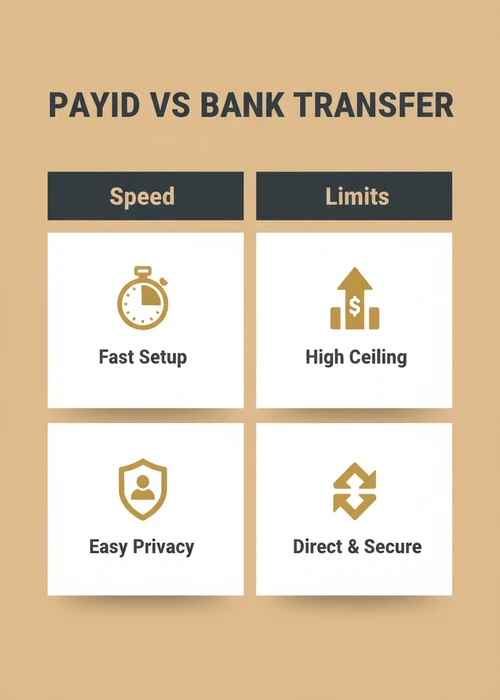
Bank Transfer vs PayID Casinos Australia for Australian Players 2026
Compare PayID and bank transfer for Australian players. See transaction speed, limits, and fees to choose the best method for fast casino deposits and payouts.
Is PayID actually different from a regular bank transfer, or just a friendlier wrapper around the same BSB-and-account-number rail underneath? In practice the two diverge sharply: PayID routes over Osko on the NPP for near-instant settlement and uses an email or phone alias instead of exposing the account number, whereas a classic bank transfer still relies on the BECS batch window with a one-to-three-day clearing time. In this Payid Vs Bank Transfer Casino breakdown the fee schedules, processing windows, daily ceilings, and the differing KYC behaviour are laid out side by side, so the choice can be made on the rail mechanics that actually matter for the size and frequency of session being run.
01
Jeetcity Casino
4.9
Card players can pay by Visa, while PayID, Neosurf and 10+ cryptos round out the methods
Quick exits — withdrawals over PayID or crypto wrap up in under a day for verified accounts
150-plus software houses — Evolution and Nolimit City included — stock a lobby of over 6,000 games
Welcome bonus
100% up to A$7,500 + 100 FS!
Curaçao (GCB)—A$30 min deposit—0–24h crypto/PayID withdrawal—6,000+ games
Many players mistakenly believe PayID is just a branded layer over bank transfers, but they operate on different settlement rails. A PayID transaction typically leverages the Osko network, whereas a standard bank transfer may rely on traditional interbank batch processing. In any Payid Vs Bank Transfer Casino comparison this distinction deeply impacts the actual time it takes for funds to appear in a casino account, especially during weekends. While both methods appear to function through a bank, the underlying mechanics can mean the difference between a five-minute deposit and a three-day wait. Understanding these differences prevents frustration and unexpected delays.
Furthermore, the choice between PayID and bank transfer affects how personal data is handled during each transaction. PayID acts as an alias, masking sensitive account numbers from the recipient side, which adds a layer of privacy. A standard bank transfer requires full disclosure of BSB and account numbers, increasing the footprint of financial information shared with the platform. For AU players, this privacy advantage can be a key consideration, particularly for those who prefer to keep their banking details more secure.
Another critical factor is the impact on withdrawal timelines and limits. Some platforms prioritise PayID withdrawals due to the instant nature of the Osko network, potentially speeding up access to winnings. Conversely, standard bank transfers, while often slower, may support higher transaction caps for significant cashouts. Choosing the wrong method for a large withdrawal can lead to unexpected delays or the need for multiple smaller transactions. Account-to-account rails now dominate the way Australians move money, a shift documented in the Reserve Bank's snapshot of how Australians pay. Understanding these nuances allows players to select the method that best aligns with their transaction volume and urgency.
The Mechanics of PayID in the AU Ecosystem
PayID is an alias service that allows users to link a bank account to a phone number, email, or ABN. It was launched by NPP Australia and is integrated into the New Payments Platform (NPP), enabling near-instantaneous movements of funds. Unlike traditional methods, PayID removes the need to share BSB and account numbers with the operator. This system simplifies the deposit process and reduces the risk of manual entry errors during transaction setup.
For AU players, PayID transactions are powered by the Osko network, which facilitates real-time settlement 24/7. This means deposits typically appear in the casino account within minutes, even on weekends or public holidays, as the major banks explain in their own guides to PayID and Osko payments. The speed is a significant advantage for those who want immediate access to their funds for gaming. However, this convenience comes with daily limits set by individual banks, which may cap the amount that can be moved per transaction.
From a security perspective, PayID enhances privacy by acting as a proxy for sensitive banking details. When making a deposit, only the registered alias is shared with the platform, not the full account number. This reduces the risk of exposing financial data to intermediaries. Despite this, all PayID transactions still undergo standard banking security checks, ensuring that funds are protected by existing bank-level encryption and fraud detection systems.
Platforms Supporting Both PayID and Bank Transfer
A selection of platforms in Australia actively supports both PayID and standard bank transfer options for maximum flexibility. Our selection process focuses on reliability, fee transparency, and minimum deposit thresholds, ensuring players can choose the method that best suits their needs. The following table outlines how leading AU-facing operators handle these two payment rails, highlighting key differences in speed and costs.
This comparison demonstrates that while both methods are widely available, their operational details can vary significantly between platforms. Players should pay close attention to the specific limits and processing times associated with each option before committing funds. The listed operators have been vetted for their consistency in handling both payment types for Australian users.
Side-by-Side Comparison: PayID vs Bank Transfer
Comparing the two methods reveals distinct differences in settlement speed and verification requirements. PayID typically offers faster deposits, while bank transfers are often more predictable for large withdrawals. The following breakdown highlights the practical differences that matter most to AU players.
Feature
PayID
Bank Transfer
Typical Deposit Limit
Typical Withdrawal Time
Typical Fees (AU)
Settlement Rail
Osko / NPP
Interbank Batch
$5,000 - $10,000
5-30 Minutes
0%
Privacy Level
High (Alias)
Medium (BSB/Account)
$2,000 - $5,000
1-3 Business Days
$0 - $20
Speed (Deposits)
Instant
1-3 Business Days
$10,000+
Under 1 Hour
0%
Speed (Withdrawals)
Fast (if supported)
Standard (1-3 days)
$5,000 - $15,000
2-5 Business Days
0.5% - 1%
Verification Needs
Account Alias
Full Details (BSB/Acc)
$15,000+
1-2 Business Days
$0 - $15
The table shows that PayID is substantially faster for deposits due to its reliance on the Osko network, with funds typically settling in under 30 minutes. Bank transfers, while slower for deposits, can sometimes be more flexible for higher-value withdrawals, though they still take significantly longer to process. Both methods are generally fee-free for AU players, but small charges can occur on certain bank transfers.
Transaction Speed Comparison
PayID deposits are typically processed instantly via Osko, whereas standard bank transfers can take 1-3 business days. This makes PayID the faster option for urgent funding, allowing players to access their accounts almost immediately. In contrast, bank transfers are better suited for non-urgent transactions where timing is less critical.
Verification Requirements
PayID transactions often require less manual verification, while bank transfers may involve BSB and account number checks. Both methods still comply with KYC standards for AU players, but the PayID process is generally more streamlined. This can result in quicker account approvals for new users.
Withdrawal Stability
Bank transfers are generally more predictable for larger withdrawals and high-value transactions. PayID may have lower daily limits depending on the user's bank, which can make it less suitable for significant cashouts. For these reasons, players often switch to bank transfers when withdrawing substantial winnings.
Five-Method Decision Matrix: Which Rail Matches Your Amount, Day, and Urgency
The two-way comparison above answers "PayID or bank transfer" but ignores the three other rails the average AU player actually has access to: PayTo (mandate-based pull on the NPP), BPAY (bill-payment scheme on a daily cycle), and Trustly or similar bank-gateway services (API-routed instant bank push). The right rail depends on three variables the cashier never asks: how much you are moving, how urgent it is, and whether the banking day is open. The matrix below maps each rail to the scenarios where it wins, and where it actively does not.
Rail
Best amount range (AUD)
Weekday speed
Weekend / holiday speed
Bank-block exposure
Withdrawal support
PayID via Osko (NPP)
Under $5,000 typical; bank-set daily cap usually $10,000-$30,000
Under 60 seconds at major-bank receivers
Same — NPP runs 24/7
High at CBA if the gambling toggle is on; lower at NAB and Westpac on PayID specifically
Supported, generally fastest withdrawal rail
PayTo (mandate)
Mandate-cap-bound; typical scope $500-$5,000 per pull
Seconds, once mandate is active
Same — NPP rail, 24/7
Medium — bank rejects pulls outside mandate scope automatically, but gambling toggle can apply if account-level block is on
Not used for withdrawals; pull-only direction
BPAY
$50-$5,000 typical; some billers extend to $10,000
Next settlement cycle, typically up to 24 hours
Cycles skip weekends — Friday after the cut rolls to Monday
Low for unique-code billers; CBA toggle can still catch shared-code BPAY to gambling categories
Not supported in either direction for withdrawals (one-way scheme)
Direct EFT (BSB / BECS)
$1,000-$20,000+ — highest per-transaction limits of the set
Next BECS cycle, same banking day if before the 5:30 PM cut
Zero — BECS does not run weekends or public holidays
Highest exposure at CBA (gambling toggle catches direct EFT to gambling accounts)
Supported, but slowest withdrawal rail (1-3 business days post-approval)
Trustly or similar bank gateway
$20-$10,000 depending on operator integration
Seconds via bank-redirect authentication
Same — runs independent of BECS cycles
Variable — block applies if the underlying push hits a gambling-tagged merchant code
Supported on some operators, less consistent than direct EFT for large amounts
The decision logic in plain language:
Under $500, any day, urgent: PayID via Osko. Settles in under 60 seconds at major banks, 24/7. The only failure mode is the receiving bank not being on the Osko overlay — in which case the deposit still arrives, just not in seconds.
$1,000-$5,000, weekday: PayTo if your bank supports it and the operator offers it; otherwise PayID. Direct EFT works for non-urgent amounts in this range but you wait for the next BECS cycle.
$1,000-$5,000, weekend or Friday after 5:30 PM: PayTo or Trustly. Direct EFT does not move until Monday morning's first BECS cycle. BPAY misses its cut too.
Over $5,000, no urgency: Direct EFT for the highest per-transaction limit and the cleanest paper trail. Plan for the cycle, not the clock.
Over $5,000, urgent: Split into PayID-cap-compatible chunks across two days, or use PayTo with a high mandate cap. Single-transaction speed at high amounts is the one thing AU rails do not deliver.
Bill-payment interface preferred: BPAY. Slowest of the five for any given amount, but the only rail that integrates with the "Pay anyone" / "BPAY" tab most players already use for bills.
Every casino calls their bank transfer "fast and secure." The real question is which rail is running underneath. A $2,000 deposit via "instant bank transfer" at the cashier might route through BPAY (next-day cycle), Trustly (seconds), or direct EFT (next BECS cycle) depending on the operator's payment provider and your bank's compatibility. Check the cashier's payment-method dropdown for the exact rail name before you click submit, and use the matrix above to predict the real arrival window.
When to Use PayID vs Bank Transfer
Choosing the right method depends on transaction size and urgency. Small, frequent deposits are ideal for PayID, while large withdrawals benefit from standard bank transfer stability. Understanding when each method shines can prevent delays and ensure funds are handled efficiently. Players should consider their typical play pattern and banking habits when selecting their preferred option.
Small and High-Frequency Deposits
PayID is the optimal choice for frequent, smaller deposits due to its speed and ease of use. It streamlines the process for players who reload often, ensuring funds are available in minutes.
Large Value Withdrawals
For withdrawing significant sums, standard bank transfers are recommended for greater stability and predictability. They are less likely to be subject to the lower caps associated with PayID.
Weekend and Holiday Play
PayID's 24/7 settlement via Osko makes it perfect for weekends and public holidays when traditional bank transfers may be delayed. This ensures uninterrupted access to funds.
Privacy-Focused Transactions
Players who prefer not to share their full bank details should opt for PayID. Its alias system keeps sensitive information hidden from the operator, enhancing financial privacy.
Recurring Low-Risk Payments
For players with consistent, low-risk payment patterns, bank transfers can be a reliable option. They are well-suited for scheduled or predictable fund movements.
In summary, the decision between PayID and bank transfer should be based on the specific needs of the transaction. Use PayID for speed and privacy, and bank transfers for larger, more predictable movements. For more information on responsible gambling practices in Australia, consider visiting ACMA's regulatory guidelines regarding online services. This helps ensure a safer and more informed gaming experience.
Common Pitfalls When Switching Payment Methods
Changing your primary payment method can sometimes trigger additional KYC checks or withdrawal delays. Incorrect PayID details can lead to payment rejection, while bank transfer errors may result in multi-day recovery times. It is important to be aware of these potential issues to avoid unexpected disruptions. Always double-check information before confirming any transaction.
One frequent issue occurs when players attempt to withdraw funds via a different method than they used for depositing. Many platforms enforce a rule that withdrawals must match the original deposit method to prevent fraud. This can lead to unexpected delays if a player tries to switch between PayID and bank transfer mid-session. Understanding these policies beforehand is crucial for smooth transaction management.
Another common pitfall is the discrepancy in daily limits between banking methods. A player might be used to a high bank transfer limit but find their PayID transactions capped at a much lower amount. This can be particularly frustrating when attempting a larger deposit or withdrawal. Verifying limits with both the bank and the platform can help avoid these inconveniences.
Limits and Fees for AU Players
PayID limits are set by individual banks but often align with Osko's general caps. Standard bank transfer fees are rare for deposits but can apply to certain types of international withdrawals. Understanding these limits and potential costs is essential for managing funds effectively. Players should review their bank's specific terms to avoid overstepping transaction caps.
On average, PayID transactions in Australia are capped around $5,000 to $10,000 per day, depending on the financial institution. This can be sufficient for many players, but high rollers may find it restrictive. Standard bank transfers typically offer higher limits, potentially reaching $20,000 or more per transaction. This makes them more suitable for larger fund movements.
While most deposits are processed without fees, some platforms may apply a small charge for bank transfer withdrawals, especially for international destinations. PayID transactions, being domestic and network-based, are generally free of such fees. It is always advisable to check the platform's fee schedule and your bank's terms to avoid hidden costs during transactions.
Security and Privacy Considerations
PayID enhances privacy by hiding your account number from the recipient. Bank transfers require full BSB and account details, which increases the data footprint during a transaction. Both methods are secured by bank-level encryption and two-factor authentication. However, the PayID system offers a distinct advantage in protecting sensitive information from exposure.
The alias system of PayID means that only a phone number, email, or ABN is shared with the operator, rather than full bank details. This significantly reduces the risk of account number misuse in the event of a data breach. Even within a secure environment, minimising shared data is a best practice for online security. This feature provides an additional layer of protection for AU players.
Regardless of the method chosen, players should always use strong, unique passwords and enable two-factor authentication (2FA) on both their banking and casino accounts. This simple step greatly reduces the risk of unauthorised access. For those who need support in managing their gambling habits, services like BetStop provide a national self-exclusion register to help maintain control. Combining technical security with responsible habits is key.
How to Safely Transition Between Methods
Safely transitioning between PayID and bank transfer involves verifying details and testing small amounts first. This approach minimises the risk of funds being sent to the wrong account. Always ensure that all information is accurate before confirming a transaction. Taking these precautions can prevent costly errors and delays.
Before making a large transfer, it is recommended to perform a small test transaction of $1 to $5. This confirms that the connection between the bank and the platform is functioning correctly. Once the test transaction is successfully processed, larger sums can be moved with greater confidence. This simple step can save players from significant frustration and potential loss of funds.
Additionally, players should update their contact information on both their bank and casino accounts to ensure that any alerts or confirmations are received promptly. This helps in monitoring transactions in real-time and identifying any issues quickly. Regular reviews of transaction history are also advised to detect and report any suspicious activity immediately. Proactive management is the best way to maintain security across different payment methods.
Final Verdict: PayID vs Bank Transfer for AU Players
For Australian players, both PayID and bank transfer offer secure and reliable ways to manage funds. PayID stands out for its near-instant deposit speeds and enhanced privacy, making it ideal for frequent, smaller transactions. Bank transfers provide greater stability and higher limits, which are beneficial for larger withdrawals. The decision ultimately depends on the individual's transaction volume and urgency. To make an informed choice, players should consider both the speed and the limits associated with each method. Choosing the right option can lead to a smoother and more enjoyable gaming experience.
Q&A
Frequently Asked Questions
Q1
What is the main difference between PayID and bank transfer for depositing?
The main difference is settlement speed, with PayID deposits processed almost instantly via the Osko network. Bank transfers typically take 1-3 business days to settle, making them slower for urgent funding.
Q2
Are there any extra fees when using PayID instead of bank transfer?
Most AU platforms do not charge extra fees for either method, though individual banks may have their own policies. It is always important to check both the platform's fee schedule and your bank's terms.
Q3
Can I use PayID for large withdrawals from AU platforms?
PayID can be used for withdrawals, but it may be subject to lower daily limits set by your bank. For very large sums, standard bank transfers are often more stable and predictable.
Q4
Is it safer to use PayID than a standard bank transfer?
Both methods are secured by bank-level encryption, but PayID offers enhanced privacy by using an alias instead of full account details. This reduces the amount of sensitive information shared with the operator.
Q5
What happens if I enter the wrong details for a PayID transaction?
Incorrect PayID details will typically result in the transaction being rejected and funds returned to your bank account. This process is generally quicker than recovering funds from a bank transfer with incorrect details. State-level support is available via Gambler's Help counselling for players who prefer in-person counselling over online chat.
Jeetcity Casino
100% up to A$7,500 + 100 FS100% up to A$7,500 + 100 FS